Introduction
Â
The most commonly administered treatment for ear infections is antibiotics. And while antibiotics can be very useful they are one of the most over-prescribed medications used today. When a dog / cat is frequently prescribed antibiotics – just like with humans, dogs / cats can become immune to the antibiotics. This can create a critical situation if a dog or cat requires antibiotics to save its life.
Antibiotics can also be counter-productive to solving the problem of ear infections. Antibiotics suppress the immune system. If an ear infection is a result of a yeast infection (Candida) or an otherwise suppressed immune system the administration of antibiotics can actually make the condition worse.
For these reasons it is important that antibiotics only be used when absolutely necessary.
Herb and fruit extracts offer a readily available, all-natural and affective alternative to treating ear irritations and infections with antibiotics. While some herbs should never be taken internally when a dog or cat is on certain conventional medications, using herb as a topical application is safe.
Dogs with floppy ears may be particularly prone to ear infections as air circulation inside the ear is limited, fur on the inside surface of the ear can become overgrown and dirt and particulate can become trapped. It is important to check your dog’s and cat’s ears on a weekly basis to ensure ears are clean.
Â
What Causes Ear Infections?
Â
Well there are many conditions that can lead to ear infections; the following provides some examples…
One – Acute Ear InfectionsÂ
This type of infection may be caused by:
- Bacteria;
- A scratch or cut inside or near the ear canal.
Two – Chronic (ongoing) Ear Infections
This type of infection may be caused by:
Allergies – caused by inappropriate food ingredients such as corn, soy and other grains, chemical based preservatives and other artificial additives such as chemical-based food colouring, etc.
- Candida (yeast infection);
- Chronic Bacterial infection;
- Hormonal unbalance;
- Stress;
- Suppressed immune system.
Three – An Infestation of Ear Mites
Ear mites are tiny spider-like insects that like to infest the ears of dogs, cats, rabbits and other small animals. Although they prefer the ear canals they can also live elsewhere on the animal’s body. The mites thrive in the moist warmth of the ear canal. They burrow into the ear, casing irritation and inflammation – the animal’s body responds to the attack by producing excess ear-wax. The ear mites feed on epidermal debris and ear wax.
Â

Four – Other Foreign Material
Such as…particulate blowing about in the wind can impact and lodge into the ear canal (i.e. dogs that stick their heads out of vehicles);
Running through or rolling-in certain grasses that have hard seed-bearing seed heads. These seed heads have sharp points and microscopic barbs that can become lodged in a dog’s ears as they run through, play or roll-about in the grass. These barbs can easily work there way into flesh – the barbs then prevent the seed head from working its way back out. Hard seed bearing grasses are often referred to as ‘Fox Tails’. The following are typical examples of ‘fox tail’ grasses:
Â
 |
Cheat grass’ (Bromus tectorum);
|
 |
Foxtail also called wild barley, squirreltail barley,
skunktail (Hordeum murinum), |
|
|
|
|
|
|
|
|
|
|
|
|
|
|
|
|
|
|
|
|
|
|
|
|
|
|
|
|
|
|
|
|
|
|
|
|
|
|
|
|
|
|
|
|
|
|
|
|
|
|
|
|
|
|
|
|
|
|
|
|
|
|
|
|
|
|
|
|
|
 |
Red Brome (Bromus madritensis);
|
 |
Rip-gut grass’ (Bromus diandrus). |
Â
Symptoms of an Ear Infection
Â
Typical symptoms of an ear infection include:
- Build-up of ear wax; when you clean the wax it redevelops quickly, i.e. within the next day or two);
- Ear sensitivity/pain – your dog may turn its head away if you try to touch its ears or may cry in pain at your touch;
- Dizziness and/or vomiting;
- Holding of the head to one side;
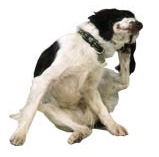
- Scratching at the ear (repeatedly, excessively, persistently);
- Shaking of the head (repeatedly);
- Strong odour;
- Swelling, redness;
Persistent scratching and/or head-shaking can also lead to Aural Hemotoma - the constant irritation can break blood vessels resulting in an accumulation of blood between the layers of skin. This condition creates a large blister-like pocket that must be drained safely by a veterinarian. The best procedure to treat this condition is surgery in which the skin is cut and the blister completely drained. Less intrusive procedures such as draining the blister with a needle or small tube are less desirable measures as the blister will usually refill with blood in a matter of hours or days.
 |
An Aural Hemotoma |
Â
Natural Options to Clean Ears, Reduce Irritation and Treat Ear Infections
Â
Please note -when administering any of the below treatments:
- Make sure that the liquid solution being dropped into or applied to your dog’s / cat’s ear is at room temperature;
- Â If the liquid is too cold you can cause additional discomfort, if the liquid is to hot you can cause discomfort and damage;
- If you need to warm the solution up to room temperature simply take the solution, place it in a vial, dropper, small glass or bowl (dropper with the open end up) and sit the vial, dropper, glass or bowl in a larger vessel (glass or bowl) that contains a little warm water -Â this will warm the solution up quickly.
- If you want to dry your dog’s / cat’s ear once the application of the treatment has been completed use a cotton ball to gently pat the ear dry;
- Gently rub/massage the ear in a circular motion, then remove your hand and let your dog/cat shake its head.Â
- You can use a cotton ball to gently wipe any excess oil off the inside of the ear flap;
- If you need to use a cotton swab to clean more precisely – never put the cotton swab past the portions of the ear that you can readily see…do not put the swab into the ear canal – you can very easily damage the ear drum either temporarily or permanently!
- Do not use any of these treatments if your animal’s ear drums are perforated/punctured.
The number of drops suggested for each flush is a typical dosage – however if your dog / cat is very small, i.e. 4 lbs, use less drops, if your dog is 150 – 200 lbs you will need to use more drops.
Â
Some of the following Ear Flush Recipes call for tinctures. Tinctures are readily available at most health food stores and on-line. If you wish you can also make the tinctures yourself.Â
Organic Apple Cider Vinegar (ACV) & Distilled Water Ear Flush – to keep ears clean, treat ear infections and reduce irritation
My personal favorite treatments – particularly for treating yeast infections (candida) of the ear is 1) Colloidal Sliver (see further below) or;
 2) ACV. Â
I use the ACV undiluted – but you can also dilute it with water as indicated below.
Organic Apple Cider Vinegar (ACV) has anti-bacterial, anti-fungal and anti-viral properties (primarily from the acetic acid and malic acid in ACV).
This herbal flush is good for treating ear infections. Use it once or twice daily if the dog has a dirty, irritated or infected ear.
While you could choose to substitute the organic ACV for non-organic – I do not recommend going with non-organic, at least not in North America. Most of the non-organic ACV produced in North America is derived from apples imported from China, where the amount of toxic pesticides and herbicides used on apples is not only more voluminous than what is applied in NA, but also poorly if not completely unregulated in many regions.
- Combine equal parts of ACV and distilled water, mix the solution;
- With a syringe or dropper, gently drop about 10 drops of the liquid into your dog’s /cat’s ear – make sure that the syringe is located at the entrance to the ear canal – the syringe should never be placed inside of the ear canal.
- Gently rub/massage the ear in a circular motion, then remove your hand and let your dog/cat shake its head.
If you would like to know more about the many beneficial uses of ACV for your dog you can read more here.
Calendula Ear Flush – to keep ears clean and reduce irritation
Use this flush once or twice daily. Calendula has anti-fungal properties. It is also very effective in promoting the healing of wounds. Cut this recipe in half for smaller animals.
Combine the following in a glass:
- 1 cup warm distilled or filtered water;
- 1 teaspoon calendula tincture;
- 1/2 teaspoon sea salt;
With a syringe or dropper, gently drop about 10 drops of the liquid into your dog’s /cat’s ear – make sure that the syringe is located at the entrance to the ear canal – the syringe should never be placed inside of the ear canal.
Gently rub/massage the ear in a circular motion, then remove your hand and let your dog/cat shake its head.
This ear flush may also be expanded to include a small amount of Meadow Anemone (Pulsatilla nigricans) tincture.
Colloidal Silver Water and Gel – reduce inflammation, treat infection
Silver is a natural and powerful broad spectrum antibiotic agent, it is also has excellent antiseptic, antifungal and disinfectant properties. Read this article to find out:
- The history of Colloidal Silver;Â
- How Colloidal Silver:
- Kills virus, fungus and bacterium;
- Speeds healing;
- How to apply it;
- How to select a quality product..
Garlic Oil Ear Flush – keep ears clean, treat ear infections, ear mites
Garlic is a powerful, natural broad-spectrum antibiotic. The active antibiotic agent in garlic is allicin (a sulfur compound). Allicin is produced when garlic is chopped, chewed or bruised. Garlic is also an antioxidant, anti-allergen, and anti-carcinogen – garlic contains germanium, an anti-cancer agent.
Garlic oil can be used to:
- Keep ears clean;
- Treat bacterial of fungal infections of the ear;
- Treatment for ear mites;
- Treat inner ear fluid and inner ear swelling;
To prepare Garlic Oil you will need:
- A small, clean wide-mouth glass jar;
- Cheesecloth or other breathable clean cloth;
- Elastic band or string;
- Amber, brown or blue storage bottle;
- Garlic cloves;
- Â Virgin, or extra virgin olive oil (cold-pressed olive oil).
Preparation:
- Remove the outer skin (also called ‘paper’) from the garlic cloves;
- Cut the garlic cloves into thin slices;
- Put the sliced garlic in the jar, leave a little space at the top of the jar empty;
- Pour the olive oil into the jar, making sure to add enough oil to completely cover the garlic – make sure that you leave some empty space at the top of the jar;
- Cover the top of the jar with a few layers of cheesecloth:
- Stretch the cheesecloth so it lays flat on top of the lid – if the cloth touches the oil it will absorb the oil and make a mess;
- Secure the cloth with string or an elastic band;
- Let the garlic/oil filled jar sit top cure, in a warm location for 10 to 14 days;
- Once the curing period is over, separate the garlic from the oil by straining the oil into an amber, brown or blue storage bottle;
- Store the Garlic Oil in the refrigerator.
Administering
- For infection and mites: twice daily, until the infection/infestation is resolved;
- For maintenance and cleaning: once a week to once a month as required to keep ears clean…
Make sure the oil is warmed up to room temperature. With a syringe or dropper, gently drop several drops of the oil into your dog’s /cat’s ear – make sure that the syringe is located at the entrance to the ear canal – the syringe should never be placed inside of the ear canal.
Gently rub/massage the ear in a circular motion, then remove your hand and let your dog/cat shake its head. You can use a cotton ball to gently swab any excess oil off the inside of the ear flap.
Garlic & Mullein Ear Flush – to keep ears clean, reduce irritation and treat ear infections
Mullein is anti-microbial and anti-viral properties. Garlic is a natural anti-biotic.This herbal flush is good for treating ear infections. Use it once or twice daily.
Combine the following in a glass:
- Equal parts of mullein oil and garlic oil;
- Combine the two oils;
- Add 10 to 20 drops of olive oil or vitamin E for every one ounce of garlic/mullein oil mixture.
With a syringe or dropper, gently drop about 10 drops of the liquid into your dog’s /cat’s ear – make sure that the syringe is located at the entrance to the ear canal – the syringe should never be placed inside of the ear canal.
Gently rub/massage the ear in a circular motion, then remove your hand and let your dog/cat shake its head.
Green Tea Flush – to reduce irritation and keep ears clean
Add two tea bags (or two teaspoons of green tea) to 8 ounces of boiling water. Allow the tea to steep and cool. Apply ½ of a dropper (about 10 drops) twice daily to irritated ear. Make sure that the dropper or syringe is located at the entrance to the ear canal – the syringe should never be placed inside of the ear canal. Gently rub/massage the ear in a circular motion, then remove your hand and let your dog/cat shake its head.
Oregon Grape Ear Flush – to keep ears clean, reduce irritation, treat ear infections and /or kill ear mites
Oregon Grape has strong antibiotic, antibacterial, anti-inflammatory and astringent properties. Apply 1 to 10 drops (depending on the size of your dog/cat) of Oregon Grape tincture to the ear twice daily until the infection is eradicated.
Yellow Dock Tea Flush- to reduce irritation and keep ears clean
Add one tablespoon of dry yellow dock to ½ cup boiling water. Allow the tea to steep and cool. Once the tea is cool, strain it so that the fluid is clear and free of particulate. Apply ½ of a dropper (about 10 drops) twice daily to irritated ear. Make sure that the dropper or syringe is located at the entrance to the ear canal – the syringe should never be placed inside of the ear canal. Gently rub/massage the ear in a circular motion, then remove your hand and let your dog/cat shake its head.
Â
Eradicating Ear Mites
Â
Garlic Oil Ear Flush – keep ears clean, treat ear infections, ear mites
Garlic is a powerful, natural broad-spectrum antibiotic. The active antibiotic agent in garlic is allicin (a sulfur compound). Allicin is produced when garlic is chopped, chewed or bruised. Garlic is also an antioxidant, anti-allergen, and anti-carcinogen – garlic contains germanium, an anti-cancer agent. See recipe and instructions above.
Yellow Dock Ear Flush
Â

Yellow dock has many medicinal properties. It astringent, anti-inflammatory, and purification properties kill the ear mites while soothing inflammation and itchiness. If your dog/cat is prone to ear mites you can use this recipe to shampoo your pet’s head, ears and tail once a week.
Combine…
3 drops of yellow dock tincture;
1 tbs of distilled water.
Apply ½ of a dropper (about 10 drops) once daily to irritated ear. Make sure that the dropper or syringe is located at the entrance to the ear canal – the syringe should never be placed inside of the ear canal. Gently rub/massage the ear in a circular motion, then remove your hand and let your dog/cat shake its head. Repeat the treatment once every three days for up to three weeks.
Â
Options for Pro-Active Maintenance / Prevention
Â
If your dog is prone to ear infections – you can also add an herb to your dog’s daily diet to help avoid infections and flush your dog’s ears occasionally.
Â
Ear Flushes
Lemon Flush for Dogs Who Swim Frequently/Daily
You can use this flush once a week during swimming season or more often if your pet swims on a daily basis
Combine…
The fresh squeezed juice of ½ a lemon;
1 cup of warm distilled water;
Strain the resulting liquid to remove lemon pulp and seeds. Apply ½ of a dropper (about 10 drops) once daily to irritated ear. Make sure that the dropper or syringe is located at the entrance to the ear canal – the syringe should never be placed inside of the ear canal. Gently rub/massage the ear in a circular motion, then remove your hand and let your dog/cat shake its head.
Lemon offers many other health benefits and uses – you can read more here.
Â
Apple Cider Vinegar and Water Flush
The ACV/Water flush recipe provided above can be used once or twice a month to keep your dog’s ears clean and free of bugs.
Adding Oils and Herbs to Your dog’s Diet
Â
Coconut Oil
Coconut Oil is an anti-bacterial, anti-fungal, anti-viral. It also boosts the immune system and provides many additional health benefits. If you would like to learn more about the benefits of giving your dog or cat coconut oil and the recommended dosages you can read this
article.
Â
Echinacea (Purple Cone Flower)
Dogs that have frequent ear infections can benefit from taking Echinacea which has anti-biotic, anti-viral and immune system stimulating properties. Dry herb of Echinacea is available in health food stores
Dogs that have frequent ear infections can benefit from taking Mullein Weed which has anti-microbial and anti-viral properties. Dry herb of mullein is available in health food stores.
Â
Dosages for Adding Herbs to Your Dog’s Diet
The table below provides a general guideline for herbs/spices based on your dog’s weight. The information provided in the table is an extract from Dr. Kidd’s Guide to Herbal Dogs Care.
Daily Amounts Based on Dog’s Weight.
Â
Dog’s Weight
|
Sprinkles
(on dog’s food once/day)
|
Teas
|
Capsules/Tablets
|
Tinctures
|
1-10 lbs
|
a small pinch
|
less than 1/4 cup, 1-3 times/day
|
1/2 capsule, 1-3 times/day
|
1-3 drops, 2-3 times/day
|
10-20 lbs
|
a bigger pinch about
|
1/4 cup, 1-3 times/day
|
1/2-1 capsule/tablet, 1-3 times/day
|
3-5 drops, 2-3 times/day
|
20-50 lbs
|
2 pinches-1 teaspoon
|
1/4-1/2 cup, 1-3 times/day
|
1-2 capsules/tablets, 2-3 times/day
|
5-10 drops, 2-3 times/day
|
50-100 lbs 10-
|
2 pinches-2 teaspoons
|
1/2-1 cup, 1-3 times/day
|
1-2 capsules/tablets, 3-4 times/day
|
20 drops, 2-3 times/day
|
Over 100 lbs,
|
up to 1 tablespoon
|
up to 1 cup 3 times/day
|
adult human dose
|
adult human dose
|
Please note certain herbs and spices do not create a hazard by themselves however they can interfere with conventional Western medicines. If you are using one of the topical flushes provided above to clean your dog’s/cat’s ear you do not need to be concerned about conflict. But if your dog is on any of the conventional medicines please make sure you consult your veterinarian before you introduce herbs to your dog’s diet.Â
Anti-inflammatory (i.e. Rimadyl)
Aspirin
Antibiotics
Cardiac drugs
Central Nervous System drugs
Chemotherapy drugs
Diabetic / Hypoglycemic drugs (i.e. Insulin)
Diuretics (i.e. Furosemide, Diazide)
Hormones (i.e. Thyroxine)
Steroids
â€áµ”ᴥᵔâ€
Related Articles
For related and additional articles on dog and cat, care, health, training, nutrition and animal advocacy go to thispage.
Feel free to leave a comment below – if your comment is polite, informative etc. I will publish it. If your comment is a quick question, I will answer it if time permits…
If you require additional assistancewith your dogs you can engage me to…
1.0) Do an in-person session(see details below)
2.0)Â Do a phone/email consultation (see details below)
1.0) In-Person Sessions are available to you if you live in the region of Ottawa-Gatineau, the Ottawa Valley and Region.
(i.e. Ottawa, Hull, Alymer, Orleans, Bells Corners, Manotick, Vars, Kanata, Stittsville, Smith Falls, Fitzroy, Carp, Arnprior, Renfrew, etc.)Â
 and surrounding areasÂ
(i.e. Brockville, Smith Falls, Perth, Kingston, L’Original, Val-des-Monte, St-Pierre-de-Wakefield, etc.)
or if you will be visiting the area from out-of-town.
Methods of Payment (for In-Person Sessions):
Cash, Email Money Transfer and Credit Card via PayPal
2.0) If you reside elsewhere you can engage my world wide consultation service, details of which are provided just below…
My Hourly Fee
$ 100.00/hour in Canadian funds.
Purchasing Consultation Time:
Client’s often start out by purchasing an hour of my time and then augment that if required to suit the situation;
Or you can – if your situation requires it, purchase whatever block of time you want (i.e. multiple hours).
Methods of Payment:
Email Money Transfer and Credit Card via PayPal
1.0 Email Money Transfer:
1 hour = $ 100.00 in Canadian Funds;
For payment via email money transfer I provide you with a password (security information).
2.0 Credit Card via PayPal
1 hour = $ 100.00 + $ 5.00 PayPal Transaction fee = $ 105.00 Canadian Funds;
For payment via PayPal I send you a PayPal invoice to enable payment.
Method of Consultation – Canada, USA and Abroad (i.e. UK, Asia, etc.)
If You Are Located In:
1.0 Canada:
I can work with you via:
Phone with follow-up by email, or;
Via email only;
The choice is yours;
If you want to work via phone you provide me with your phone number and I will call you at the mutually agreed upon Consultation time.
2.0 USA:
I can work with you via:
Phone with follow-up by email, or;
Via email only;
The choice is yours;
If you want to work via phone:
You call me at the following number 613-622-7958, at the mutually agreed upon consultation time.
3.0 ALL OTHER GLOBAL LOCATIONS (i.e. UK. Asia, etc.):
I can work with you via:
Via email only, or;
Phone with follow-up by email…
The choice is yours;
If you want to work via phone:
You call me at the following number 613-622-7958, at the mutually agreed upon consultation time.
To Set-up a Consultation
Step 1 – Identify how you would prefer to pay for the consultation;
 Payment options as noted above are:
o   email money transfer, or;
o   Credit card via Paypal.
Step 2 – Identification of a consultation time that works for both our schedules;
Step 3 – You then pay the fee for the amount of consultation time you want to purchase;
Step 4 – Consultation takes place on the agreed upon time.
Contact me at
Office 613-622-7958
Cell 613-293-3707
Ottawa Valley Dog Whisperer Services
Training;
Behaviour Modification;
Rehabilitation;
Nutrition;
Health
Whether you are experiencing dog behavior problems and would like assistance, or just want to bring your dog up to be a well-balanced canine -Â I offer both a local and international service for people with one or multiple dogs.Â
I work with all breeds – from small (i.e. Yorkie, Pomeranian, Chihuahua, etc.), medium breeds size (including Pit Bulls) and large breed dogs…
International e-ConsultationÂ
Contact me at
Office 613-622-7958
Cell 613-293-3707
ur Modification, Rehabilitation – Ottawa, Ottawa Area, Outaouais, Ottawa Valley
International e-ConsultationÂ
Contact me at
 email ottawavalleydogwhisperer@gmail.com
Office 613-622-7958
Cell 613-293-3707
 L:Â n/a
 I:Â 11,700
 Rank:Â 3018
 Age:Â n/a
 I:Â n/a
 whois
whois source
 Rank:Â 800


 Â Â Â Â Â Â Â Â Â Â Â Â Â Â Â Â Â Â Â Â Â Â Â Â Â Â Â Â Â Â




 click picture for link
 Click Picture For Link


 Â


